A first inspection
Look above and below the plan.
Open the fixed sketch, then switch from Plan View to Section View. Inspect the overhead line, elevated railway and mine below the illustrative ground datum. Tap or click a feature for its description.
The two views expose what this interpretation has placed in space. They do not establish that those placements, levels or interfaces are correct. Compare another variant to find a different drawing or assumption, not a higher score.
Open the fixed plan and section →1 · Early enquiry
AI interpretation of interfaces, topology and system architecture
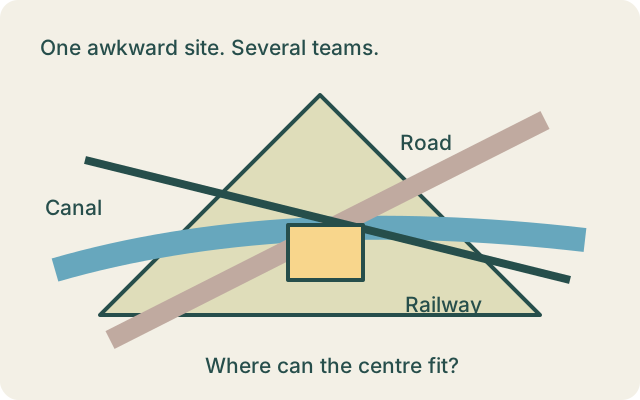
A regional signalling control centre occupies a fictional triangular site, with a canal, road, railway viaduct, overhead power line and mine passage. These six variants expose different interpretations of that brief so their diagrams, assumptions, omissions and interface questions can be inspected side by side. They are separate explorations, not a ranked sequence or a single settled design.
Evidence boundary: this collection is not an empirical AI benchmark: it supplies no controlled model comparison, scored reference interpretation or repeatability study. Its drawings and architecture alternatives do not establish engineering feasibility or safety.
Site geometry and topology
A compact plan and section. Switch views and inspect feature annotations to see how the brief has been placed in space.
Inspect the fixed sketch → Boundary interpretation · selectable featuresConcept geometry sketch
Select boundary features, show or hide illustrative bands, and read the feature relationships in plan and section.
Explore boundary interpretations → Interactive cuts and bands · PNG exportConceptual plan and section
Adjust assumed bands, move and snap the section cut, and export the resulting plan and section drawings.
Adjust a cut and its bands → Topology and levels · SVG exportInterface topology sketch v0
Vary assumed bands and levels, compare two section cuts, and inspect signed distances from the site centre. The readout is geometric, not a risk ranking.
Inspect topology and levels → Architecture options · three alternativesThree architecture alternatives
Compare three conceptual arrangements, the interface questions each raises, and potential benefits and trade-offs to investigate.
Compare the alternatives → System boundary · nine open interfacesArchitecture v0 and interface register
Inspect a candidate modular arrangement and system boundary, then follow nine interface questions and the evidence or agreement each needs.
Open the architecture and register →2 · Later enquiry
Local-to-global compatibility and composition
Essay 003 deliberately changes the question. Five declared local exclusion rules are tested against the same sampled candidate locations. The result says whether those rules admit a shared candidate in the toy model; it does not measure how well AI understood the original brief.
Open Essay 003: the Tangled Triangle compatibility lab → Begin with Balanced → No global fit → Balanced; read the sampled candidates and their margins.