Foray 140 · Independent project experiments

Local to Global

A control centre must fit onto the Tangled Triangle: a fictional site crossed by a canal, road, railway viaduct, overhead power line and old mine passage. Different accounts of the same place raise two different questions.

Early enquiry · Six distinct variants

How has AI interpreted the brief?

Explore the early interpretations
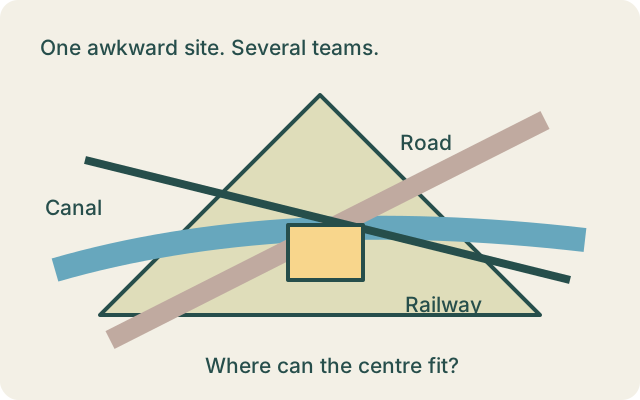
Schematic triangular control-centre site crossed by road, railway and canal
Site emblem, not a surveyed layout. The variants also expose the power-line and mine interfaces.

Inspect the interfaces, topology and system architecture implied by sketches, sections and arrangements. Notice what each interpretation makes visible, assumes or omits.

First look: switch the fixed sketch from Plan View to Section View. Compare the overhead line, raised railway and mine below ground.

These are exploratory interpretations, not a ranked sequence, measured AI benchmark or engineering proof.
Later enquiry · Seven separate essays

Can the declared local rules agree?

Try the compatibility lab
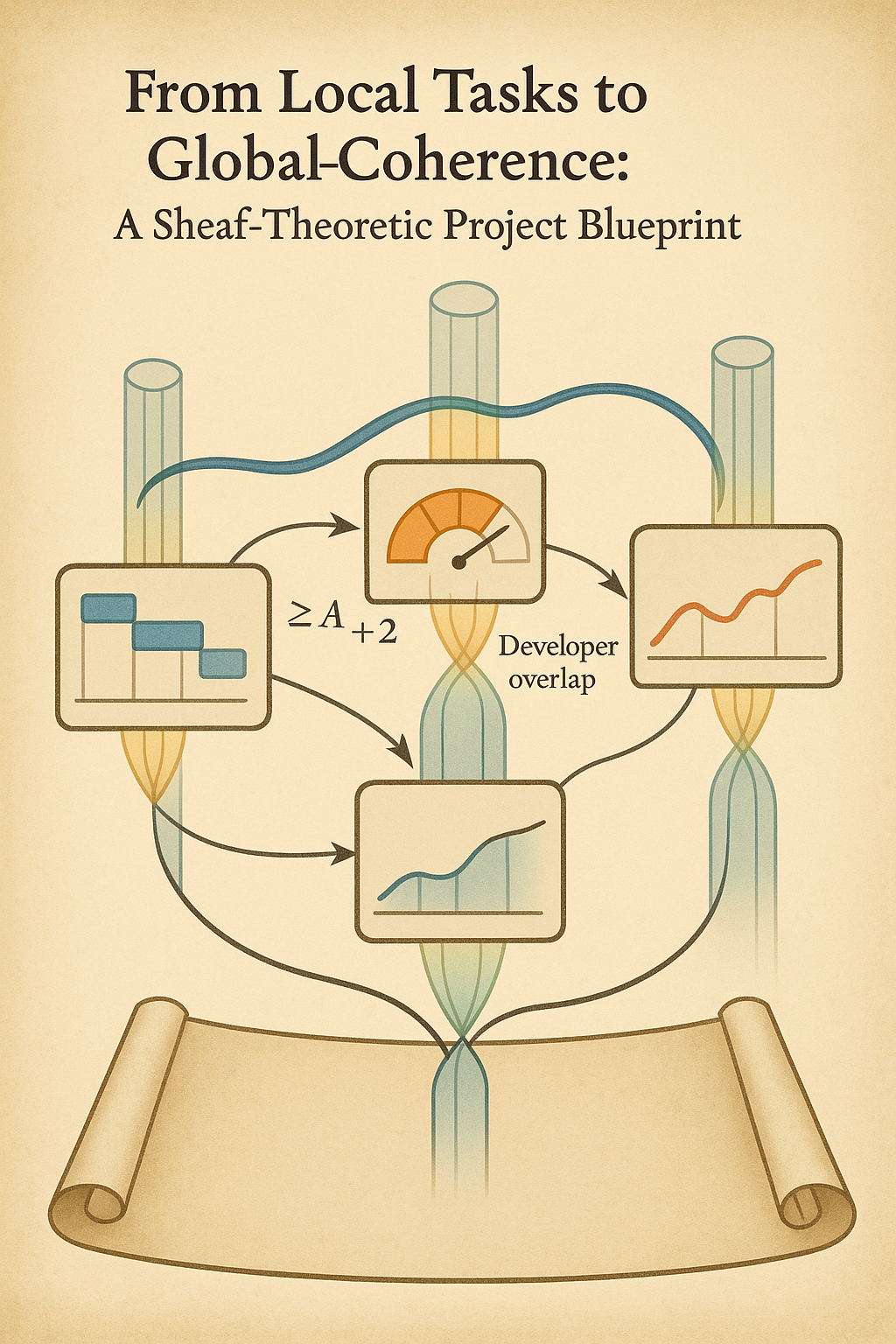
Existing illustrated blueprint connecting local project tasks to global coherence
A mnemonic for the later enquiry. The illustration is not the checker or evidence for its result.

Keep each local account useful, then make its shared boundaries explicit. The Triangle compatibility lab tests five exclusion rules against the same candidate locations.

First try: compare Balanced with No global fit. Read why the strongest sampled candidate still fails a rule, then restore Balanced.

A finite declared-rule check. It does not assess AI understanding, prove a whole sheaf construction or establish a real site's feasibility.

Browse all seven compatibility essays

Reading the first result

A failed candidate can tell you where to look.

The balanced Triangle rules admit 91 of 462 sampled locations. The No global fit preset admits none. At the strongest remaining sample, the canal margin is −11 units: that location fails one of the five rules.

The preset changes several buffers. That candidate diagnosis does not attribute the whole loss of candidates to the canal alone. Zero passing grid points also does not establish that every point between samples is impossible.

From idea to check

Make agreement inspectable.

Source idea

Daniel Rosiak’s Sheaf Theory through Examples, named in the source trail, provides the formal questions about local accounts, restriction to overlaps and gluing compatible sections. Choosing the parts and comparison maps is itself a modelling decision.

Read the retained sources and interpretation

Executable construction

In Essay 003, each candidate receives five signed margins. It passes exactly when every declared margin is non-negative. In Essay 001, six explicit interface rules compare fictional package fields and separate conflicts from missing information.

M(x) = min(m₁(x), …, m₅(x))
sample passes when M(x) ≥ 0

What the result leaves open

A compatible sample is a candidate under supplied rules. It supplies neither a survey nor an engineering assessment. The finite checks do not establish the stronger sheaf condition of unique gluing.

Read the Triangle’s construction and limits

Working principles across the later essays
  • Local first. Keep each team’s own useful view before attempting composition.
  • Overlaps explicit. Say which facts must agree across which interfaces.
  • Failure is evidence. A mismatch can locate an obstruction rather than merely create a red light.
  • Checker, not oracle. Language models may propose structure; declared rules judge compatibility.
  • Plural essays. Hold concrete attempts apart until integration is earned.

The later enquiry

All seven compatibility essays

Scope, state, schedule and risk pose different modelling questions. These remain separate attempts, with stable essay numbers—not one settled formalism for every project. For a second hands-on example, try Scope coherence and distinguish a resolved interface from a fully reconciled set.