State, readout and update
Myers-style lenses separate what a system holds internally, what it exposes, and how input changes it. The toys make these ingredients inspectable.
state s → readout r(s)
state s + input a → update u(s, a)
Foray 120 · An open enquiry
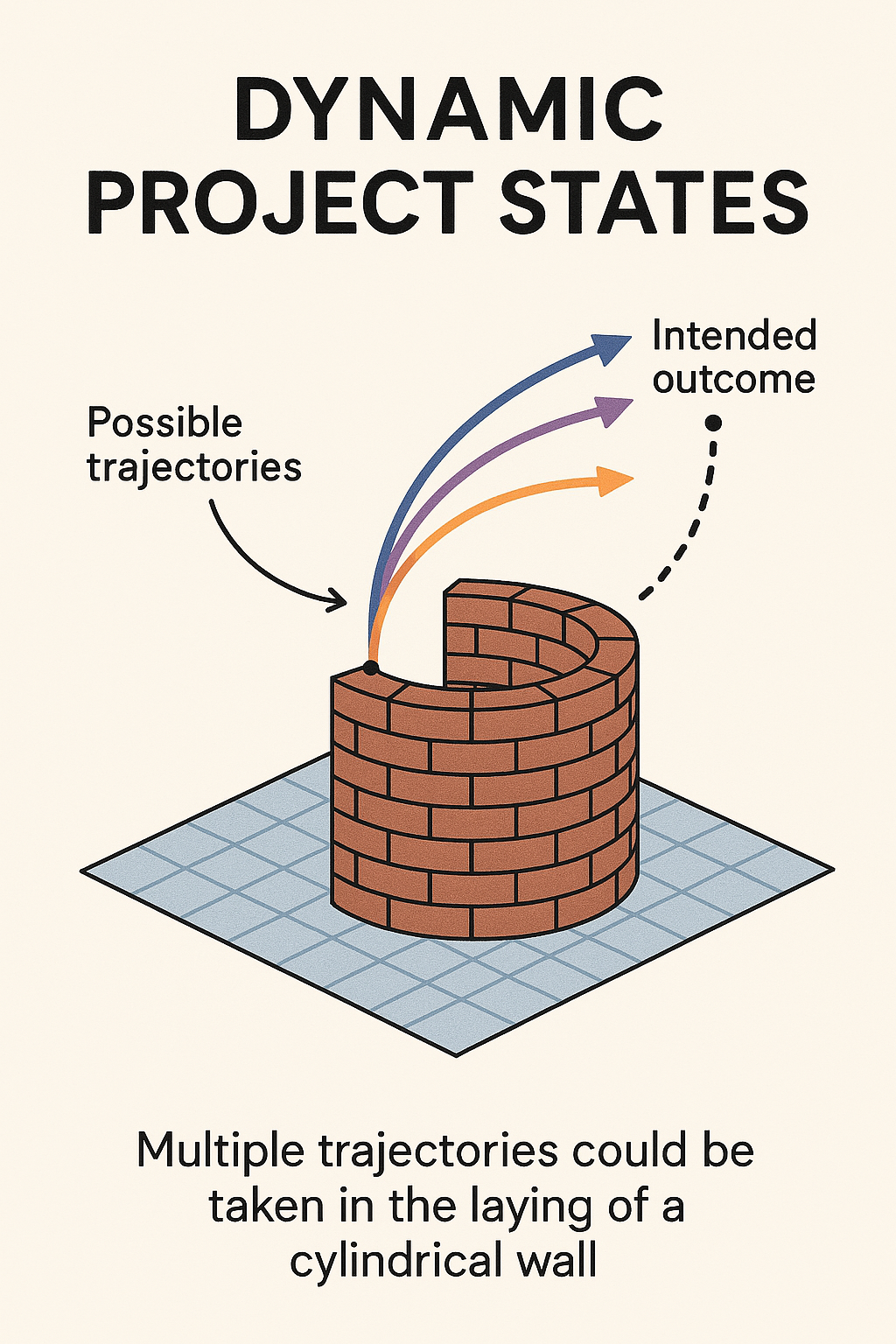
Build a circular brick wall, course by course. The same amount of finished work can hide different choices, readiness or available lifting capacity.
What must a project state remember to generate what can happen next?
Start with choices and policiesNew here? Begin with the small brick-cylinder primer, #12.
First try · Essay 12
Keep the policy on Manual. Choose clockwise, then press Step course. Choose anticlockwise and step another course.
The two completed rows and ↻↺ record what happened. The branching tree still shows the unrestricted direction choices, with your history highlighted.
A choice selects one action; a policy supplies a rule for choosing; a trajectory is the resulting history. This primer has no physical curing or shared-resource model.
Read the primer’s model and limitsLatest construction · Essay 13 · September 2026
Two miniature brick rings now share a hoist pool. Add placement rules, curing timers and a full-completion goal; construct reachable states and generate completing paths.
Open the constructive experimentWith the default model loaded, press Next tick →. Ring A starts its first brick and reserves the sole hoist. The replay shows one permitted next step, while the model contains the other possible paths.
Then compare one hoist with two. Changing the wiring can change both the completion time and which state summaries preserve the necessary distinctions.
From source idea to construction
Myers-style lenses separate what a system holds internally, what it exposes, and how input changes it. The toys make these ingredients inspectable.
state s → readout r(s)
state s + input a → update u(s, a)
A policy selects an admissible action at each state. Iterating updates generates a history. In the finite toys, the action fibre is a set, not a tangent vector space.
policy σ → s₀, s₁, s₂, …
Shared resources constrain joint actions. Essay #13 then refines a proposed summary until it preserves action-labelled futures, the goal and unit costs.
That refinement is an added finite construction, not a theorem supplied by the lens notation.
Inspect wiring in #9 · Formal construction and source mechanisms · Method and proof obligations
The primer separates choices from histories. The later finite construction can generate and replay a completing path under its explicit support, placement, curing, clock, resource and goal rules. Its reported results belong to those assumptions; they are not forecasts or engineering validation.
The unresolved practical question is which necessary state distinctions can actually be observed. A similar progress report can conceal different readiness and future options. Rewiring resources requires a fresh test of any summary.
The continuous tab in #13 is a separate smooth cylinder toy: a section selects a vector field, and its integral curve is a trajectory. It is not a proved continuous limit of the brick model. Read the result and its boundaries.
Explore a particular question
Each keeps a distinct purpose: spatial routes, partial observation, timing, wiring, weather windows, simple choices or sufficient state. Original numbers are stable; gaps mark consolidated earlier attempts.
These links also work if the searchable index cannot load.