Interactive examples
Decisions & trade-offs
What are we deciding, and what do we give up?
Frame a decision, compare competing objectives, and separate delay distributions from dependence.
Each example makes a limited idea inspectable. Read its assumptions, try a change, and ask what would be needed before using it on a real project.
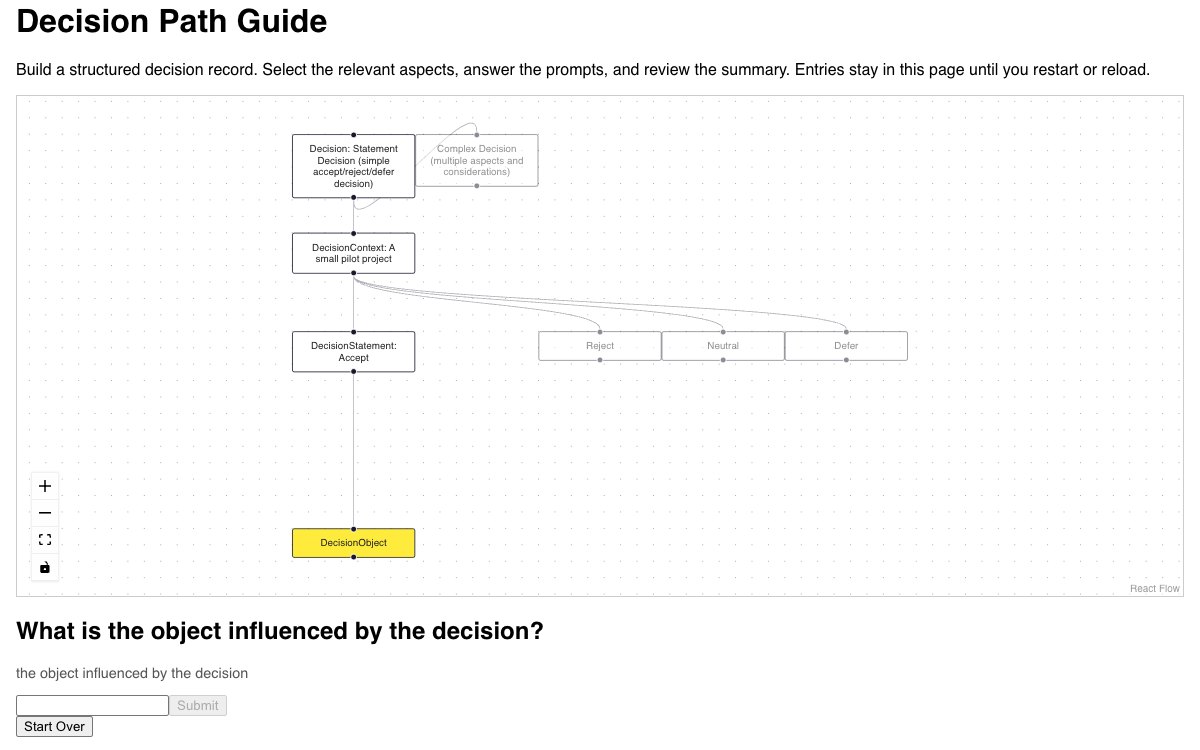
Find the kind of decision you are making
Use an ontology-inspired questionnaire to distinguish decision objects, statements and processes.
What to try & what it leaves out
Try. Try the same situation as a decision to be made and as an existing decision statement; compare the resulting paths.
Limits. A guide to useful distinctions, not an automatic decision maker or a complete ontology reasoner.
Earlier example, repaired and reviewed 2 October 2026. This review checks the stated model and interactions; it does not establish usefulness in practice.
Editable source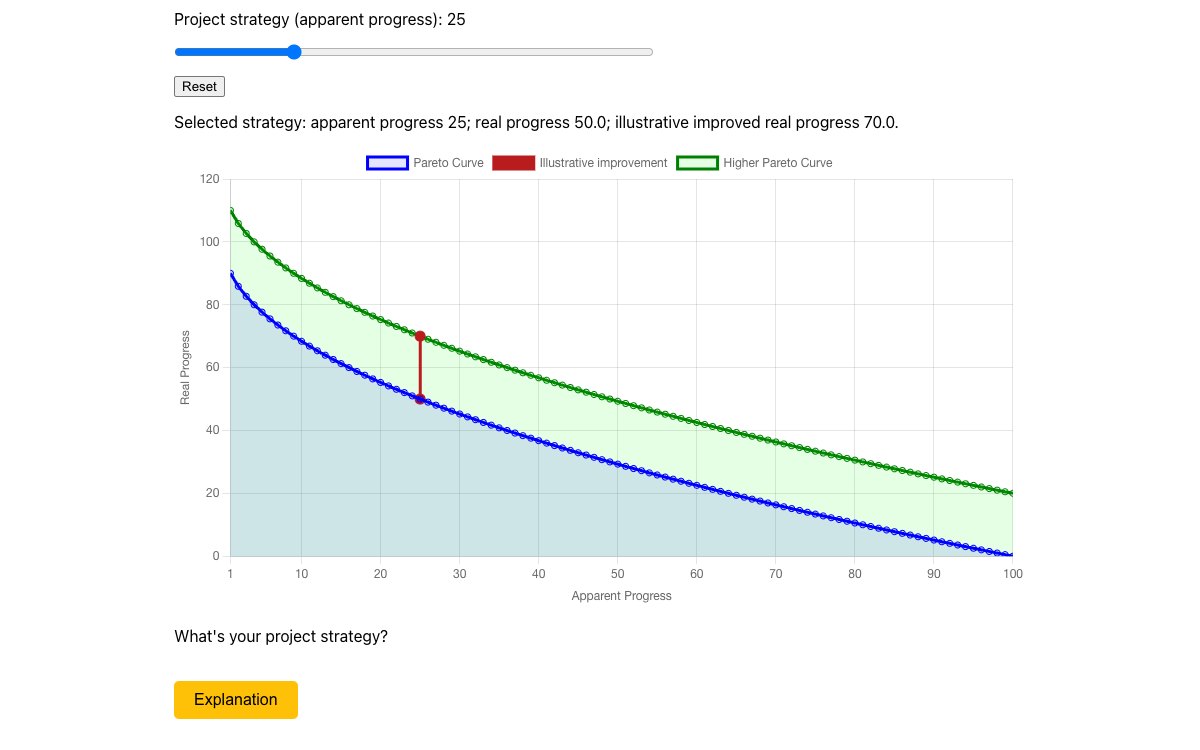
Find a better trade-off together
Compare allocation along a frontier with an illustrative outward change in what is possible.
What to try & what it leaves out
Try. Explore the points and the two objectives. Distinguish a better position on a frontier from improving the feasible options.
Limits. A drawn, illustrative frontier. The app does not derive an optimum, establish orthogonality or prove a win-win is feasible.
Earlier example, repaired and reviewed 2 October 2026. This review checks the stated model and interactions; it does not establish usefulness in practice.
Editable source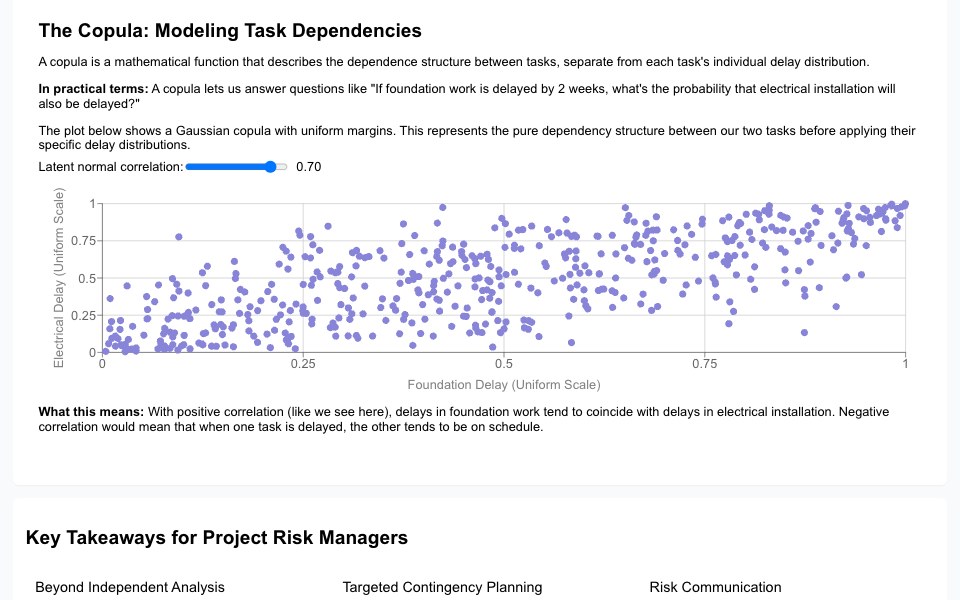
When do task delays happen together?
Separate each task’s delay distribution from their joint dependence.
What to try & what it leaves out
Try. Inspect the fixed marginal distributions, change the Gaussian dependence parameter and sample size, then compare the scatter and tail summaries.
Limits. Synthetic draws and a Gaussian copula. Its parameter is not generally the Pearson correlation of the displayed delays; extreme-tail dependence is not represented.
Earlier example, repaired and reviewed 2 October 2026. This review checks the stated model and interactions; it does not establish usefulness in practice.
Editable sourceRelated reading: Project data models · Frameworks · Information & methods.