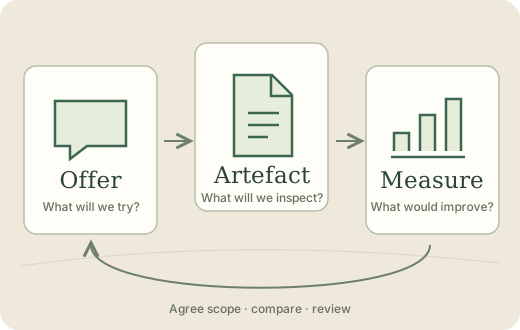
Start with a real decision
A programme director wants a better weekly risk review. A useful starting offer might produce a source-linked risk summary. Its test would check missed changes, unsupported statements and the time needed to review it against the current process.
These are authored design options and trial questions, not a list of services currently delivered or evidence of performance. Any target, tool choice and delivery commitment still needs agreement.
Keep three things connected
1. Offer
Who needs help, with which decision? Name an owner, a bounded task and the current way of doing it.
2. Artefact
What could that person inspect or use? Specify its inputs, approval point and the assumptions it must reveal.
3. Measure
Agree a unit, denominator, starting value, comparison, observation period and reviewer. Include error and review effort.
Measures below are proposed definitions, not measured results or recommended thresholds. A faster output is useful only if its quality and consequences remain acceptable.
Find a starting point
No matches. Try a broader term or clear the filters.
Service options
Choose the kind of help worth discussing. Facilitated and analytical work can be combined with a bounded automation trial; the labels do not rank their value.
Strategic alignment workshop
Facilitated & analytical
- Offer to discuss
- Make competing objectives and trade-offs explicit with the people who own them.
- Artefact to inspect
- Strategy map, objective hierarchy and an alignment scorecard with recorded disagreements.
- Measure to agree
- Traceability: count agreed objectives with an owner and a link to an agreed strategic goal, divided by all objectives in scope. Report unresolved disagreements separately.
- Scope and limits
- One decision or programme, named decision-makers and a dated strategy. Agreement in a workshop is not evidence that benefits have been delivered.
Project chartering
Facilitated & analytical
- Offer to discuss
- Agree a starting mandate, boundaries and decision rights before detailed delivery planning.
- Artefact to inspect
- Charter, responsibility matrix (RACI), governance model and an assumptions log.
- Measure to agree
- Unresolved mandate questions at approval, and subsequent changes attributed to an ambiguous starting scope. Compare against an agreed review checklist, not a universal clarity score.
- Scope and limits
- One project and its sponsor. Record scope exclusions, budget basis and who may approve a change; a charter is a baseline for discussion, not a guarantee.
PMO establishment and improvement
Facilitated & analytical
- Offer to discuss
- Design a project-management office around decisions it must support and services it can sustain.
- Artefact to inspect
- PMO handbook, process playbooks, measures and a staged improvement roadmap.
- Measure to agree
- Cadence adherence: completed, useful decision reviews divided by planned reviews in an agreed period. Pair the count with a sample of decisions and user feedback.
- Scope and limits
- A named office, service boundary and staffing assumption. Use the separate capability worksheet to examine current and future capabilities; this option provides no maturity rating.
Integrated master scheduling
Facilitated & analytical
- Offer to discuss
- Join dependencies, calendars and resource assumptions into a reviewable delivery plan.
- Artefact to inspect
- Integrated schedule, what-if scenarios, resource view and float map.
- Measure to agree
- Track milestone forecast error in days at a fixed forecast horizon; record over-allocation hours by resource and period. Check forecast quality as well as utilisation.
- Scope and limits
- Defined work packages, reporting cut-off and resource calendars. Record missing links and constraints; a critical path calculation cannot validate its input assumptions.
Risk and issue management
Facilitated & analytical
- Offer to discuss
- Make uncertainty, existing problems and response ownership visible to decision-makers.
- Artefact to inspect
- Risk and issue registers, mitigation backlog, assumptions and optional simulation outputs.
- Measure to agree
- Response follow-through: agreed actions completed by their due dates divided by actions due. If using expected monetary value, state each probability, cost basis and dependency assumption.
- Scope and limits
- A decision horizon and a consistent risk scale. Keep realised issues separate from uncertain events; changes in a score are not automatically risk reduction.
Change and communications planning
Facilitated & analytical
- Offer to discuss
- Work with affected people to define what must change in everyday work and what support is needed.
- Artefact to inspect
- Stakeholder map, readiness questions, communications calendar and feedback record.
- Measure to agree
- Adoption: people completing an agreed new task successfully divided by people asked to try it. Record support effort and who was not represented in the sample.
- Scope and limits
- One change, affected groups and a review window. Ask about experience directly; attendance, message reach and expressed enthusiasm do not establish adoption.
Benefits realisation tracking
Facilitated & analytical
- Offer to discuss
- Connect delivered outputs to changes in practice and to benefits someone is accountable for.
- Artefact to inspect
- Benefits map, measure catalogue, dashboard and benefit-owner review notes.
- Measure to agree
- For each benefit, specify unit, starting value, target, observation date and owner. Show observed change and the assumed project contribution separately; record delay from output to outcome.
- Scope and limits
- A defined beneficiary and benefit period. Include costs and adverse effects; a dashboard does not establish attribution.
Assisted workflow orchestration
Automation option
- Offer to discuss
- Explore whether software assistance can draft routine task updates and route them for review.
- Artefact to inspect
- Workflow graph, permission and escalation rules, draft tickets or changes, and execution log.
- Measure to agree
- Compare median request-to-approved-action time with the existing process. Report correction rate, reviewer time and failed or duplicated actions over the same cases.
- Scope and limits
- One workflow and approved systems. Define human approval points and a recovery route before any external action; automation coverage alone is not value.
Digital-twin dashboard trial
Automation option
- Offer to discuss
- Test whether a model linked to observations gives a useful warning or a better decision.
- Artefact to inspect
- Model with stated boundaries, timestamped data feed, anomaly log and simulation snapshots.
- Measure to agree
- Mean absolute error: average absolute difference between prediction and observation, in a stated unit and horizon. Also measure alert-to-action time, missed events and false alarms.
- Scope and limits
- One observable process, update interval and decision. Label stale or missing data. A visual dashboard is not evidence that a simulation matches the real system.
Generative scenario lab
Automation option
- Offer to discuss
- Use drafted alternatives to widen a planning conversation, then test them against explicit constraints.
- Artefact to inspect
- Scenario set, constraint checks, risk–utility comparison and narrative briefs.
- Measure to agree
- Count materially different feasible alternatives after independent review. Record violated constraints and review effort; compare with alternatives produced by the existing planning method.
- Scope and limits
- A bounded decision and agreed utility criteria. Generated scores are proposals for scrutiny; this guide calculates neither return on investment nor confidence in it.
Assisted backlog review
Automation option
- Offer to discuss
- Explore clustering and draft priorities to help an owner review accumulated work.
- Artefact to inspect
- Cluster report, candidate work list, proposed goals and rationale log.
- Measure to agree
- Staleness: items without an owner review within a locally agreed age divided by items in scope. Track accepted suggestions, important omissions and total review time.
- Scope and limits
- One backlog with explicit priority rules. The owner approves priorities; point estimates and cluster similarity do not prove alignment with a goal.
Knowledge-graph commons
Automation option
- Offer to discuss
- Explore a shared map of project entities and relationships, with links back to evidence.
- Artefact to inspect
- Graph, vocabulary or ontology, source links and repeatable query examples.
- Measure to agree
- Precision at five: relevant results among the first five, judged against a fixed query set and relevance rule. Pair this with time to find a supported answer and the rate of broken evidence links.
- Scope and limits
- An agreed corpus, access rules and vocabulary owner. Validate extracted relationships; graph connectivity and semantic similarity do not establish truth.
Assisted compliance review
Automation option
- Offer to discuss
- Explore how change detection and draft comparisons can support an accountable review of requirements.
- Artefact to inspect
- Source-linked change report, suggested policy or clause edits, review decisions and audit trail.
- Measure to agree
- On a reviewed sample, count missed relevant changes and false flags; measure elapsed time from a confirmed change to an approved response. State what the sample cannot cover.
- Scope and limits
- Named requirements, authoritative versions and a qualified reviewer. Suggested text is not a legal or conformity conclusion; approval remains explicit.
Project conversation review
Automation option
- Offer to discuss
- Use meeting notes or voluntary feedback to surface topics a facilitator should check with the team.
- Artefact to inspect
- Source-linked topic summary, discussion map and agreed follow-up questions.
- Measure to agree
- Ask participants whether summaries are accurate and useful. Record corrections and follow-through on agreed actions, with a stated response rate; do not infer a morale score.
- Scope and limits
- A consented set of material and an agreed retention boundary. Invite people to correct interpretations; language alone does not establish wellbeing or intervention efficacy.
Predictive resource-levelling trial
Automation option
- Offer to discuss
- Compare a proposed forecast and allocation method with a transparent planning baseline.
- Artefact to inspect
- Bottleneck forecast, candidate roster, skill and availability map, and constraint checks.
- Measure to agree
- Over-allocation hours per resource and period; feasible assignments divided by proposed assignments. Record service shortfalls and schedule effects alongside forecast error.
- Scope and limits
- A defined resource pool and planning horizon, with skills, availability and labour constraints. A planner approves changes; no automatic reassignment is implied.
Questions worth testing
Use these eight areas to challenge or extend an offer. Each question connects to a service option above. The questions preserve the original breadth of ideas without assuming a particular product, release date or performance result.
AI augmentation4 questions
Would a learned schedule forecast improve a decision?
- Option to explore
- Compare a time-series model with a simple forecast using the same dated schedule snapshots.
- Artefact to inspect
- Forecast comparison with a fixed horizon and error log.
- Measure to agree
- Forecast error in days on later, held-out milestones; data preparation and retraining effort.
- Scope and limits
- Avoid future information leaking into training. Test on the project type and reporting cadence that matter.
Could a draft work breakdown expose missing work?
- Option to explore
- Draft work packages and responsibilities from a narrative scope, then review them with delivery owners.
- Artefact to inspect
- Work breakdown and responsibility matrix with assumptions and source references.
- Measure to agree
- Reviewer-confirmed omissions, incorrect responsibilities and time to reach an approved version.
- Scope and limits
- Fix the source scope and review rubric. Completeness must be judged by the team, not by the generator.
Could retrieved evidence make risk summaries more useful?
- Option to explore
- Draft a summary from a bounded risk log and related evidence, preserving links to source passages.
- Artefact to inspect
- Risk narrative with citations, contradictions and unresolved questions.
- Measure to agree
- Supported statements divided by checked statements, plus missed material changes and review time.
- Scope and limits
- Use dated sources and access controls. Retrieval can miss evidence; a fluent summary is not assurance.
Would a learned allocation policy beat a simpler rule?
- Option to explore
- Compare an experimental optimiser with a transparent heuristic under the same demand scenarios.
- Artefact to inspect
- Candidate allocations, constraint violations and a scenario comparison.
- Measure to agree
- Over-allocation hours, unserved demand and computation time across the chosen scenarios.
- Scope and limits
- State stochastic demand assumptions and hard constraints. Keep infeasible results visible and human approval explicit.
Immersive collaboration3 questions
Would a shared spatial walkthrough resolve a site question?
- Option to explore
- Try a model-based remote walkthrough for a specific coordination or inspection question.
- Artefact to inspect
- Annotated model, observation record and list of checks still requiring a site visit.
- Measure to agree
- Correctly resolved issues and reviewer effort, compared with drawings or video for the same task.
- Scope and limits
- Check model currency, registration accuracy, accessibility and what cannot be observed remotely.
Would a spatial meeting room help this distributed team?
- Option to explore
- Compare a shared virtual workspace with the team’s ordinary meeting format.
- Artefact to inspect
- Persistent workboard, decisions and action record.
- Measure to agree
- Participant-reported accessibility and usefulness, plus unresolved decisions and setup time.
- Scope and limits
- Offer a usable non-headset route. A sense of presence does not establish effective collaboration.
Would a schedule overlay clarify work at the point of use?
- Option to explore
- Prototype a timeline aligned to a model or work area without assuming a particular headset exists.
- Artefact to inspect
- Dated overlay prototype and model-to-schedule link table.
- Measure to agree
- Task-identification errors and time to answer a defined sequencing question.
- Scope and limits
- Check alignment, data freshness and safe use conditions; compare with a simple marked-up plan.
ESG & sustainability dashboards3 questions
Can a carbon ledger trace its supplier data?
- Option to explore
- Explore an emissions record built from identifiable supplier and activity data.
- Artefact to inspect
- Ledger with source, unit, boundary, factor version and missing-data flags.
- Measure to agree
- Records with traceable evidence divided by records in scope; quantify missing data and uncertainty separately.
- Scope and limits
- Agree the emissions boundary and calculation method with a competent reviewer. No regulator API or automatic disclosure compliance is assumed.
Which material loops are practical enough to compare?
- Option to explore
- Map reuse and recovery routes before testing alternative procurement scenarios.
- Artefact to inspect
- Material-flow graph with quality, quantity, destination and transport assumptions.
- Measure to agree
- Recoverable mass under each scenario, plus cost, transport and quality constraints.
- Scope and limits
- Specify functional equivalence and actual acceptance routes; a graph loop does not prove a viable reuse market.
Would local water evidence change a project choice?
- Option to explore
- Compare site demand and phase timing with suitable dated water availability or stress evidence.
- Artefact to inspect
- Location and time-aligned exposure map with dataset limitations.
- Measure to agree
- Demand relative to the selected local availability measure, reported with units, season and uncertainty.
- Scope and limits
- Check dataset resolution and local relevance. A regional index cannot by itself forecast site-level disruption.
Low-code orchestration3 questions
Could a drafted approval flow reduce routine effort?
- Option to explore
- Translate a plain-language process into a reviewable flow, including rejection and exception routes.
- Artefact to inspect
- Approval flow, role permissions and test cases.
- Measure to agree
- End-to-end processing time, correction rate and failed or duplicated approvals in a controlled trial.
- Scope and limits
- Agree who is allowed to act and what needs approval. Prompting a flow does not establish that it is safe to run.
Can a chat request become a dependable data workflow?
- Option to explore
- Draft the connections between systems, then inspect transformations, credentials and failure handling.
- Artefact to inspect
- Workflow definition, data contract and recovery runbook.
- Measure to agree
- Correct end-to-end runs divided by test runs, including missing data, retry and duplicate-event cases.
- Scope and limits
- Use an approved test environment and bounded permissions before working on live systems.
Would execution traces explain a workflow failure?
- Option to explore
- Inspect recorded tool calls, inputs, outputs and errors to locate an operational failure.
- Artefact to inspect
- Trace timeline, error classification and reproducible failing case.
- Measure to agree
- Time to identify and reproduce known faults, plus gaps in the recorded trace.
- Scope and limits
- Traces show recorded execution, not private model reasoning. Exclude unnecessary sensitive content and check retention.
Compliance & governance automation3 questions
Could a policy comparison focus an expert gap review?
- Option to explore
- Compare policies with a named, authorised set of requirements and ask a reviewer to decide relevance.
- Artefact to inspect
- Requirement-to-evidence table with candidate gaps and reviewer decisions.
- Measure to agree
- Missed relevant gaps and false flags against an independently reviewed sample.
- Scope and limits
- Use the applicable version and full context. A document comparison is neither certification nor a conformity decision.
Can operational traces support a specific control claim?
- Option to explore
- Link recorded events to a defined control, while identifying evidence that must come from elsewhere.
- Artefact to inspect
- Control-to-evidence map, provenance and collection log.
- Measure to agree
- Required evidence items that are retrievable and verified divided by items in the agreed sample.
- Scope and limits
- Ask the reviewer what is sufficient. Collection and technical observability do not prove that a control operated effectively.
Could extracted clauses improve obligation follow-up?
- Option to explore
- Draft an obligation register from an agreed contract, preserving clause context and amendments.
- Artefact to inspect
- Clause-linked obligations, owners, dates and unresolved interpretations.
- Measure to agree
- Reviewer-confirmed omissions and incorrect obligations, plus overdue confirmed actions.
- Scope and limits
- An authorised reviewer resolves legal meaning. Neither extraction nor a cryptographic record determines whether an obligation is met.
Knowledge-graph intelligence3 questions
Would a shared vocabulary improve project search?
- Option to explore
- Compare keyword and semantic retrieval over an agreed corpus, with explicit terms and entity identities.
- Artefact to inspect
- Vocabulary, graph links and a labelled test-query set.
- Measure to agree
- Precision at five and time to a supported answer, judged using the same query set.
- Scope and limits
- Check permissions and ambiguous names. Similar wording is not evidence that two project objects are identical.
What evidence would justify a delay-propagation claim?
- Option to explore
- Draw proposed causal links and distinguish observed association from assumptions about interventions.
- Artefact to inspect
- Causal diagram, assumption register and alternative explanations.
- Measure to agree
- Testable predictions and sensitivity to disputed assumptions; record where evidence cannot distinguish explanations.
- Scope and limits
- A graph or software estimator does not establish causality. Use intervention estimates only when identification assumptions can be defended.
Could changing language signal a knowledge-map review?
- Option to explore
- Compare terms and relationships across dated corpus samples and ask owners to inspect changes.
- Artefact to inspect
- Vocabulary change log and candidate mappings for review.
- Measure to agree
- Useful alerts divided by reviewed alerts, missed known terminology changes and review effort.
- Scope and limits
- Define the comparison period and stable reference set. Changing language may reflect project change rather than an error.
Advanced analytics2 questions
Would a model explanation help a delay-risk review?
- Option to explore
- Inspect which recorded inputs influence a prediction, then check the explanation with subject experts.
- Artefact to inspect
- Prediction explanation, model limitations and data-quality review.
- Measure to agree
- Prediction error on held-out cases, explanation stability and reviewer understanding of its limits.
- Scope and limits
- Feature attribution describes model behaviour; it does not establish a cause of delay or the right intervention.
Would faster simulation change the planning decision?
- Option to explore
- Compare a simple implementation with a faster one on the same uncertainty model.
- Artefact to inspect
- Reproducible simulation, convergence check and scenario comparison.
- Measure to agree
- Runtime at a stated hardware setup and error tolerance; stability of decision-relevant results as runs increase.
- Scope and limits
- State distributions and dependencies. More runs or faster hardware cannot repair an unrealistic model.
Human factors & wellbeing2 questions
Could voluntary workload feedback prompt useful support?
- Option to explore
- Start with direct, voluntary discussion of workload and support needs instead of inferring burnout from biosignals or keystrokes.
- Artefact to inspect
- Agreed workload review, team-level themes and support actions.
- Measure to agree
- Participant-reported usefulness and completion of agreed actions, with response rate and privacy limits.
- Scope and limits
- No diagnosis, individual surveillance or health prediction. Agree consent, access and a route to seek appropriate support.
Could draft themes help a team shape its retrospective?
- Option to explore
- Group consented feedback into proposed topics, then let participants correct and choose them.
- Artefact to inspect
- Editable topic map and participant-agreed discussion agenda.
- Measure to agree
- Accuracy and usefulness as rated by participants, plus actions they choose to follow through.
- Scope and limits
- Do not treat inferred emotion as a fact or a proxy for psychological safety. Keep dissent and minority views visible.
Choose the right conversation
This guide helps shape a bounded offer and its test. Service Trident starts with a perceived need and organisational level. Portfolio-office capability review examines what an organisation has now and needs later. Service options here are not individual capability assessment rows.
Nothing is uploaded or saved. Search and expansion last only for this visit. Use the browser’s link address for a named question or service; every item has a stable anchor.
Prepare a contribution to a board decision
Start with the decision or recommendation. Give just enough context to show why it matters now, then explain the current state, the financial and operational implications, and the next steps with owners and dates.
- For a measure, show its source and date, trend, target, variance, drivers and any proposed corrective action. Distinguish checked data from unresolved assumptions.
- Frame risk through its impact, likelihood and time horizon; show mitigations, owners and review dates. Identify what needs the board’s decision.
- Explain cost, savings or revenue implications where supported, together with resource needs and when benefits might appear. Label estimates.
- Keep the pre-read concise and readable; define acronyms, make comparison graphics self-explanatory, and prepare for likely questions.
Before the meeting, check that the ask is explicit, sources are current enough for it, assumptions are visible, and responsibilities and timing are clear. Three to five summary bullets may help, but completeness matters more than a fixed count.
Recovered from the earlier “Skills for Board Meeting Contributions” guide. This is a preparation checklist, not evidence of approval or a substitute for the board’s own requirements.