Edits stay in this tab until you save or export them.
How to use this example
- Select scenarios in the list. Search and type filters only change the list, not your selection.
- Edit a scenario's timing, assumed strength, signed effects, weight or lagged links. A positive effect means stress; a negative effect means relief.
- Inspect each decision month's stress, relief and net pressure. Move a milestone using its month field or by dragging its line.
- Compare one scenario swap before applying it. A quieter selection is a different set of assumptions, not a better plan or a mitigation.
- Export your model or explicitly save it in this browser. Imports from the original CSPL example are also supported.
The original timeline starts in January 2025 and its scenarios start in 2026. The first milestone therefore sits before the selected pressures. This is a feature of the supplied assumptions, not evidence of safety.
Scenario assumptions
Shared monthly scale
When the assumptions overlap
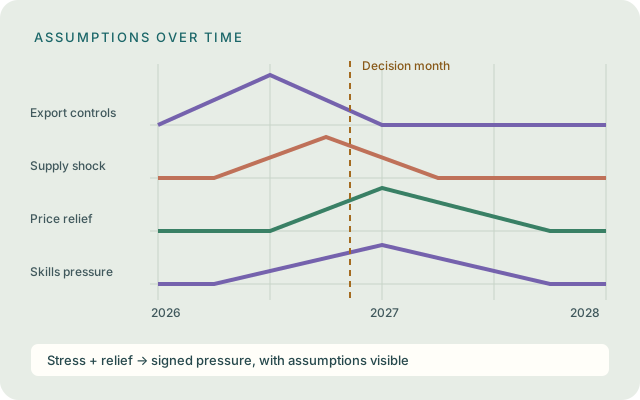
Each curve shows activation on the same 0–2 scale. Milestone lines can be dragged; their month fields below provide keyboard and touch alternatives. Dates are evaluated by calendar month.
Read the monthly numbers
Stress, relief and their difference
Decision milestones
Stress and relief sum the positive and negative contributions separately. Net pressure is their difference, within each dimension. The attention index sums positive net pressure and applies the review emphasis factor. It has no percentage or probability interpretation.
Change an assumption set
Compare a scenario swap
A swap removes one selected scenario and adds another. Compare the recomputed milestone values before applying it. There is no claim that these scenarios are equally plausible, controllable or mutually exclusive.
What does the model calculate?
Each scenario has a triangular activation curve over its time window, with a shoulder of at least one month on either side. Its height is multiplied by the assumed strength and weight. Strength is the source's “confidence” field; it is an authored amplitude, not an estimated chance of occurrence.
A declared lagged link adds or subtracts a scaled copy of its source's base activation at a later month. Both scenarios must be selected. Earlier source months still contribute when they fall before the visible timeline, so moving the view start does not reset pressure. This happens once: propagated activation does not propagate again, even around a cycle. Total activation is clipped to 0–2; clipping is reported.
The six signed effects multiply activation. Pairwise dot products describe same-direction alignment and opposition between those effect vectors. Two stresses align, as do two reliefs. Opposing effects can cancel in the net; neither index is a measure of benefit or a causal interaction discovered from evidence.
How are the discussion prompts chosen?
The source supplies twelve prompt texts: two thresholds for each effect dimension. This version only tests positive net pressure, multiplied by the review emphasis factor 1.3 − 0.6 × tolerance. It shows the matching prompt for up to three highest-pressure dimensions. Negative effects no longer trigger stress mitigation prompts.
This is an explicit heuristic. It does not optimise commitments, test their effects, establish their authority or show that they remain valid across alternative futures. Changing tolerance changes emphasis and prompt thresholds, not the scenario effects.
What was corrected from the original?
The original Chrono-Speculative Portfolio Loom described tensor networks, credal sets, uncertainty bounds, forecasts and commitments surviving top-ranked futures. Its implementation contained the smaller model explained here. Those wider methods and results were not implemented.
Its “robustness” score treated relief as a penalty and improved when an irrelevant scenario was selected. This version exposes the actual contributions and uses an unnormalised attention index. Manual before/after swaps replace a timing-only suggestion that did not evaluate the added scenario's effects. The original scenarios and useful controls are preserved, with their changes recorded in the source and preservation note.